
The Quiet Revolution of AI Agents
How autonomous AI assistants may reshape digital work
Introduction
Most people interact with artificial intelligence through tools that respond to prompts.
You ask a question. The system generates an answer. You request an image. The system produces one. In these interactions, the human remains firmly in control of the process.
A new stage of artificial intelligence is beginning to emerge.
Instead of responding to single prompts, AI systems are starting to perform sequences of actions in order to complete a task. These systems are often described as AI agents.
An AI agent can be given an objective rather than a single question. It may then search for information, organise data, interact with digital tools, and refine its output step by step until the task is complete.
While still in early stages, this shift represents an important change.
Artificial intelligence is moving from systems that respond to instructions toward systems that can carry out processes.
This development may quietly reshape how many forms of digital work are performed in the years ahead.
Why Most People Haven’t Noticed Yet
Despite the growing discussion around AI agents, most people have not yet encountered them directly.
The majority of current AI tools still operate in a conversational format. You ask a question, the system responds, and the interaction ends. The responsibility for taking further steps remains with the user.
AI agents introduce a different approach.
Instead of responding once, an agent can perform a series of actions designed to reach a specific outcome. For example, an agent might gather information from several sources, organise the findings, generate a summary, and present the results as a structured report.
To the user, this may feel less like asking a question and more like assigning a task.
However, because these systems are still developing, their use is not yet widespread. Many organisations are experimenting with them quietly in the background rather than deploying them publicly.
This is why the change often feels gradual rather than dramatic.
Yet the underlying shift is significant. Artificial intelligence is beginning to move beyond generating responses and toward performing workflows.
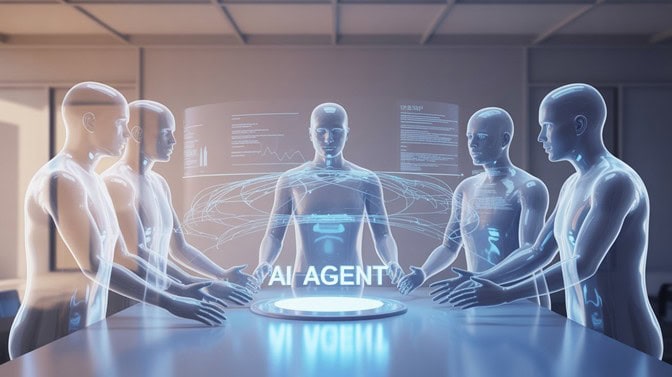
What AI Agents Actually Do
An AI agent differs from a typical AI tool in one important way.
Instead of producing a single response, an agent can carry out a sequence of actions designed to achieve a goal.
Imagine asking an AI system to prepare a research summary. A traditional language model might generate an answer based on its training data and the prompt you provide. An AI agent, however, may approach the task differently.
It might begin by searching for relevant sources. It may then extract key information, compare ideas across multiple documents, organise the material into themes, and finally generate a structured summary.
Each step becomes part of a small workflow.
Some agents can also interact with other digital systems. They may retrieve information from databases, send instructions to software tools, or perform repetitive digital tasks that normally require manual effort.
In this sense, AI agents function more like assistants carrying out a process rather than tools producing a single response.
However, it is important to recognise that these systems are still limited.
AI agents do not operate independently in the way humans do. They follow instructions, rely on predefined tools, and operate within boundaries set by the people who design them. Their effectiveness still depends heavily on the clarity of the objective and the structure of the workflow they are given.
Even so, the concept introduces a new stage in the evolution of artificial intelligence.
Instead of helping with isolated tasks, AI systems are beginning to assist with entire processes.
Where AI Agents May Change Work First
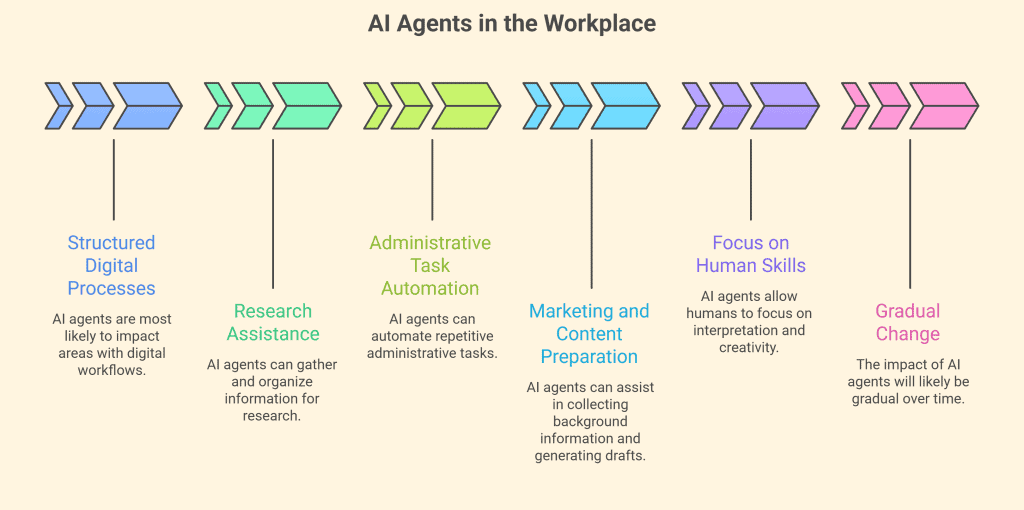
The early impact of AI agents is most likely to appear in areas where work already follows structured digital processes.
Many modern tasks involve a sequence of predictable steps. Information must be gathered, organised, analysed, and presented. In these environments, the ability for software to move through a defined workflow can create meaningful efficiency.
Research is one example.
Instead of manually searching for sources, reading multiple documents, and compiling notes, an AI agent could assist by gathering information from several sources and organising the key findings into a structured overview.
Administrative work provides another example.
Many organisations handle large numbers of repetitive digital tasks such as preparing reports, organising data, or processing standard communications. AI agents may help manage these workflows by completing routine steps automatically while leaving oversight and final decisions to human staff.
Marketing and content preparation may also see early adoption.
An agent might collect background information on a topic, identify key themes, generate initial drafts, and organise ideas for refinement by a human writer or editor.
In each case, the goal is not to remove human involvement entirely.
Instead, AI agents may reduce the time spent on repetitive digital steps, allowing people to focus more on interpretation, creativity, and decision making.
The change may appear gradual at first, but over time it could alter how many forms of knowledge work are organised.
Why Human Guidance Still Matters
As AI agents become more capable, it may be tempting to assume that digital systems will eventually manage complex processes entirely on their own.
In reality, these systems still depend heavily on human guidance.
An AI agent can follow instructions, gather information, and move through a workflow, but it does not understand the broader context in which its actions take place. It cannot fully evaluate the consequences of a decision, recognise subtle changes in circumstances, or take responsibility for the outcome of a process.
Those responsibilities remain human.
For this reason, the most effective use of AI agents is likely to involve collaboration rather than replacement. Humans define the objective, establish the boundaries, and evaluate the results. The agent assists by carrying out the routine steps that support the process.
This relationship is similar to many other forms of automation.
Software systems have long helped manage financial records, logistics operations, and data analysis. Artificial intelligence simply expands the range of tasks that software can assist with.
The role of the human decision maker does not disappear. Instead, it shifts toward supervision, interpretation, and refinement.
Understanding this relationship helps maintain perspective.
AI agents may become powerful assistants in many areas of work, but they remain tools operating within frameworks created and managed by people.
Final Reflection
Technological change does not always arrive through dramatic breakthroughs.
Often it appears quietly, through gradual improvements that slowly reshape how work is organised. Artificial intelligence may follow this pattern.
Much of today’s attention focuses on the ability of AI systems to generate text, images, and ideas. These capabilities are impressive, but they represent only one stage in the evolution of the technology.
AI agents introduce a different possibility.
Instead of responding to individual prompts, these systems begin to assist with entire workflows. They can gather information, organise tasks, and move through sequences of actions designed to reach a defined outcome.
For many forms of digital work, this may lead to subtle but important changes.
Routine processes may become faster. Small teams may be able to accomplish more with fewer resources. Individuals may find themselves supported by digital assistants capable of handling parts of complex workflows.
Yet the central role of human judgement remains.
People still define the objectives, interpret the results, and carry responsibility for the outcomes of the processes they oversee.
Seen from this perspective, the rise of AI agents may not be a dramatic replacement of human work. Instead, it may represent a gradual expansion of how digital tools assist human effort.
A quiet revolution, unfolding step by step.
About the Author