The Human Skill AI Cannot Replace
Why judgement and wisdom remain essential in an AI-assisted world
Introduction
Artificial intelligence is advancing rapidly.
Modern systems can generate text, analyse data, produce images, translate languages, and assist with many forms of intellectual work. These capabilities often create the impression that machines are beginning to replicate human thinking.
It is natural to wonder which human abilities might eventually be replaced.
Yet throughout the development of artificial intelligence, one limitation continues to stand out. AI systems can process patterns and generate responses, but they do not possess the deeper understanding that comes from lived experience.
They do not carry responsibility for decisions. They do not experience consequences. They do not develop wisdom through time.
These qualities remain uniquely human.
As artificial intelligence becomes more capable, the most valuable skill may not be technical expertise alone. Instead, it may be the ability to apply judgement wisely in situations where technology can only provide suggestions.
Understanding this distinction helps place artificial intelligence in its proper role.
It is a powerful tool for generating possibilities, but it cannot replace the human capacity to decide what those possibilities mean.
When Capability Is Mistaken for Understanding
One of the reasons artificial intelligence appears so powerful is that it produces outputs that resemble human communication.
AI systems can explain ideas, summarise complex topics, and generate thoughtful responses to questions. When reading these outputs, it is easy to assume that the system understands the information it presents.
But capability is not the same as understanding.
Artificial intelligence operates by recognising patterns across enormous collections of data. It predicts which words, images, or ideas are most likely to follow a given input. The result can appear intelligent, but the system itself does not experience the meaning behind the information.
Human understanding works differently.
People interpret ideas through the lens of experience. They consider context, relationships, and long-term consequences. They reflect on past outcomes and apply those lessons when making decisions.
Artificial intelligence does not possess this form of awareness.
It can generate options, but it cannot determine which option carries the most responsibility, the greatest risk, or the deepest significance. Those judgements require human perspective.
Recognising this difference allows us to appreciate both the strengths and the limits of AI systems.
The Role of Wisdom in an AI World
As artificial intelligence becomes more capable at generating information, the distinction between knowledge and wisdom becomes increasingly important.
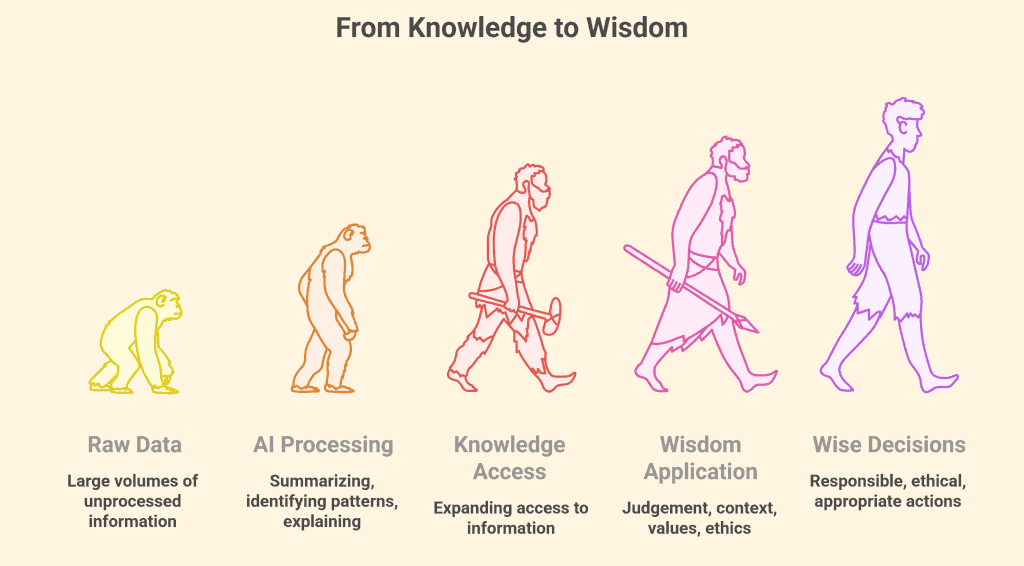
AI systems are highly effective at processing large volumes of data. They can summarise research, identify patterns, and produce coherent explanations in a fraction of the time it would take a person working alone.
In this sense, artificial intelligence can expand access to knowledge.
Wisdom, however, operates on a different level.
Wisdom involves judgement about how knowledge should be applied. It considers context, consequences, and human values. It requires an awareness of uncertainty and the ability to balance competing priorities.
These qualities develop through experience rather than computation.
A machine can generate a list of possible solutions to a problem. It cannot fully understand which solution is responsible, ethical, or appropriate in a particular situation. Those decisions require perspective shaped by real-world experience.
In an AI-assisted world, this distinction may become more visible.
When information becomes easier to generate, the value of wisdom increases. The challenge is no longer simply finding answers, but deciding which answers deserve attention and how they should be applied.
Artificial intelligence can assist with exploration, but wisdom guides the direction in which that exploration leads.
Where Human Judgement Still Leads
Artificial intelligence can assist with many forms of analysis, but real decisions often involve factors that extend beyond data.
In business, leaders frequently make choices where the available information is incomplete. Market conditions may change, people may react unpredictably, and long-term consequences are rarely fully visible at the moment a decision is made. AI systems can provide useful insights, but they cannot carry the responsibility for choosing a direction.
Education presents a similar situation.
Teachers do far more than present information. They interpret the needs of individual students, adjust their approach based on context, and guide learning in ways that depend on empathy and experience. These subtle human judgements shape how knowledge is absorbed and applied.
Even in everyday life, important decisions rarely depend on information alone.
People weigh personal priorities, relationships, values, and future possibilities when deciding how to act. These considerations often involve nuance that cannot be captured fully by data or algorithms.
Artificial intelligence can contribute useful perspectives in these situations, but it does not replace the role of human interpretation.
The technology can generate possibilities. Human judgement determines which possibilities become reality.
The Partnership Between Tools and Wisdom
Artificial intelligence is most powerful when it operates as a partner to human thinking rather than a substitute for it.
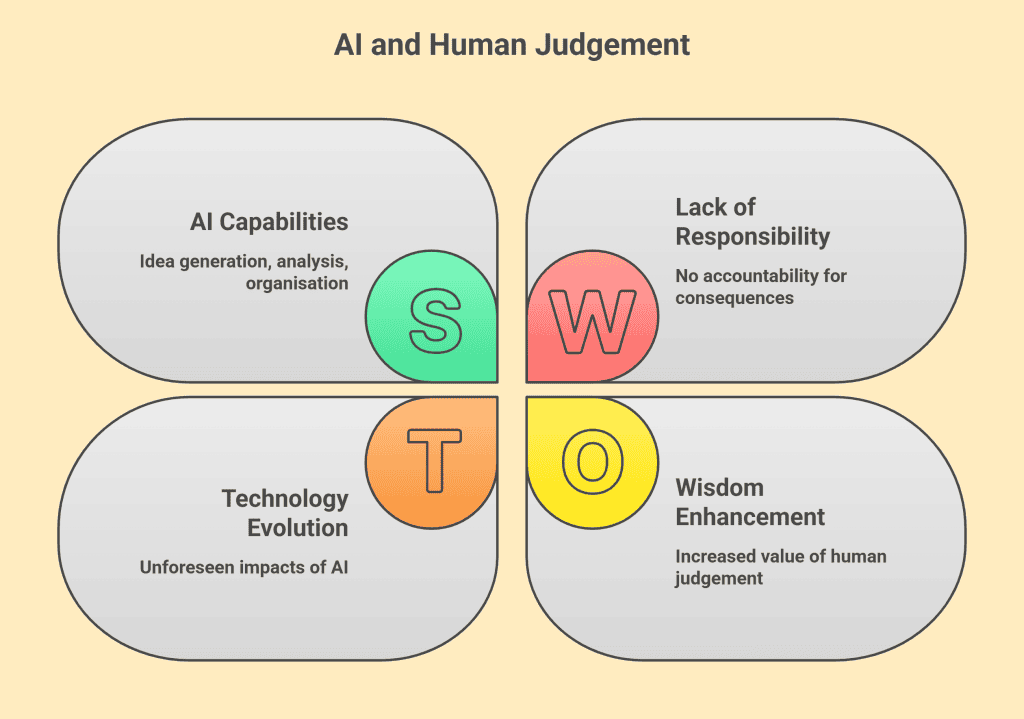
AI systems can help explore ideas quickly. They can organise information, generate possibilities, and assist with analysis that might otherwise take considerable time. In doing so, they expand the range of options that people can consider when approaching a problem.
But the presence of more options does not automatically lead to better decisions.
Someone still needs to evaluate those options. Someone must consider the broader context, weigh the potential consequences, and determine which direction aligns with human values and long-term goals.
This is where wisdom plays its role.
Wisdom allows people to recognise that not every technically possible solution is the right one. It helps individuals balance efficiency with responsibility, innovation with caution, and opportunity with ethical consideration.
Artificial intelligence can support the process of thinking, but it cannot carry the responsibility for choosing a path.
The most effective use of AI therefore involves collaboration between capability and judgement. Machines assist with generating possibilities, while humans provide the wisdom needed to decide which possibilities should be pursued.
In this partnership, technology extends what people can accomplish, but human understanding continues to guide the outcome.
Final Reflection
Artificial intelligence is becoming an increasingly powerful presence in modern life.
It can generate ideas, analyse information, assist with communication, and help organise complex tasks. As these capabilities continue to improve, it is natural to ask how far machines might eventually extend into areas once considered uniquely human.
Yet the rise of artificial intelligence also reveals something important.
Technology can process information at extraordinary speed, but understanding what that information means still requires human perspective. Machines can generate possibilities, but they do not carry responsibility for the consequences of those possibilities.
That responsibility remains human.
In many ways, artificial intelligence may make wisdom more valuable rather than less. When answers become easier to produce, the real challenge shifts to deciding which answers matter and how they should be applied.
This is where human judgement continues to lead.
Artificial intelligence may expand the tools available to us, but it does not replace the deeper qualities that guide thoughtful decisions. Those qualities develop through experience, reflection, and the responsibility of living in the real world.
Technology will continue to evolve.
Human wisdom will continue to shape how it is used.
About the Author