
The Age of Amplified Intelligence: How AI Expands Human Capability
Introduction
Each wave of technological change brings predictions about replacement.
When computers entered workplaces, many feared they would eliminate large numbers of jobs. When the internet arrived, some believed entire professions would disappear. Similar concerns are now being expressed about artificial intelligence.
AI systems can write text, generate images, analyse data, and assist with complex tasks. As these tools improve, it is natural to ask whether machines will eventually replace human work altogether.
But history suggests a different pattern.
Most transformative technologies do not simply replace human capability. Instead, they amplify it. They allow individuals and small teams to accomplish far more than was previously possible.
Artificial intelligence may represent another step in this long progression.
Rather than replacing intelligence, these systems may increase the reach of human thinking by accelerating tasks that once required large amounts of time and effort.
Understanding this shift helps frame AI not as a competitor to human capability, but as a powerful extension of it.
The Replacement Narrative
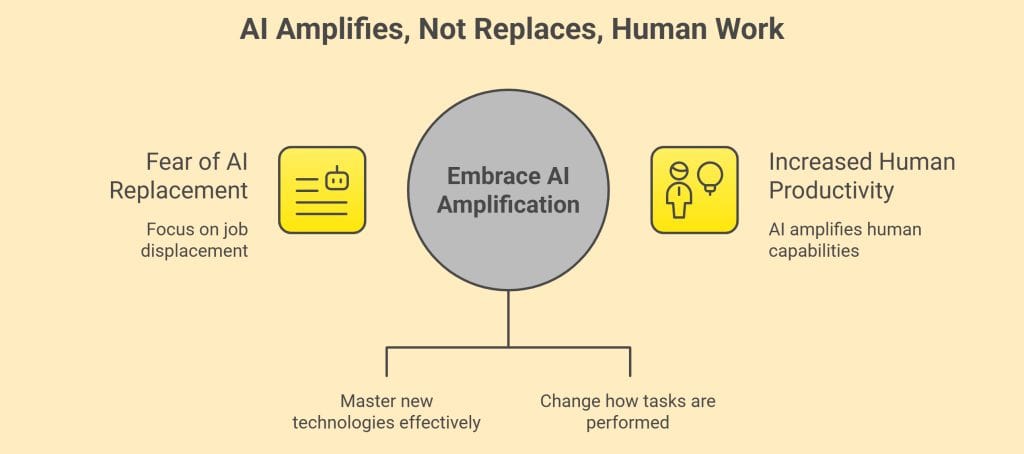
Much of the discussion around artificial intelligence is framed around the idea of replacement.
Headlines often ask which professions will disappear, which industries will be disrupted, and how many workers may be displaced by intelligent machines. These questions attract attention because they focus on uncertainty and risk.
However, this perspective overlooks an important pattern in the history of technology.
When new tools appear, they rarely remove the need for human capability entirely. Instead, they change how work is performed. Tasks that were once slow or difficult become easier, while new opportunities emerge that were previously impossible.
The printing press did not eliminate writers. Computers did not eliminate analysts. The internet did not eliminate communication. Each technology altered the environment in which these activities took place.
Artificial intelligence is likely to do the same.
While some routine tasks may become automated, the overall effect may be to increase the productivity of individuals who know how to use these tools effectively.
In other words, the central story may not be replacement, but amplification.
The Amplification Principle
Throughout history, many of the most important technologies have functioned as amplifiers of human capability.
A telescope does not replace eyesight, but it extends how far we can see. A printing press does not replace thought, but it expands how widely ideas can travel. A computer does not replace calculation, but it accelerates how quickly complex problems can be solved.
Artificial intelligence may operate in a similar way.
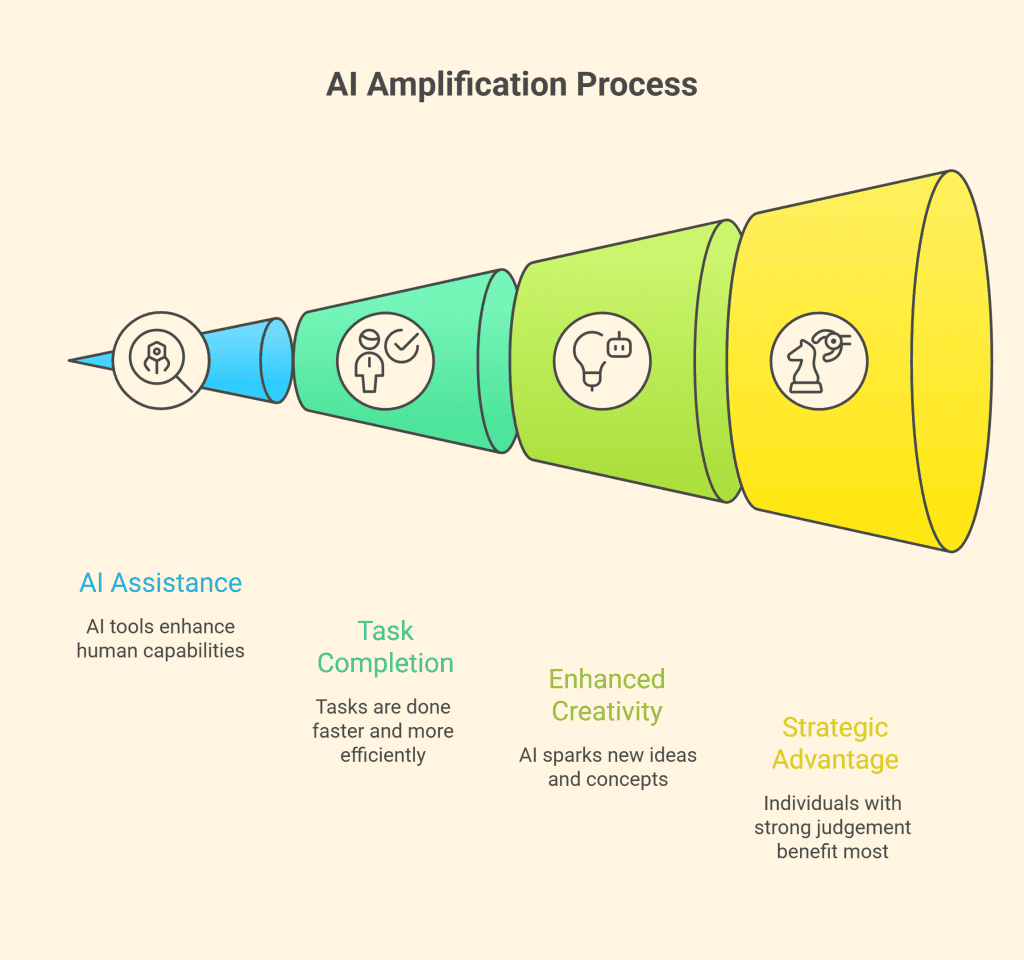
Rather than replacing human intelligence, AI systems can expand what individuals are able to accomplish. Tasks that once required large teams or long periods of effort can now be completed more quickly with the assistance of intelligent tools.
Writers can explore ideas faster. Researchers can analyse information more efficiently. Designers can generate visual concepts within minutes. Entrepreneurs can test and refine business ideas with greater speed.
In each case, the technology does not remove the need for human thinking. Instead, it amplifies the effect of that thinking.
This principle has important implications.
If artificial intelligence acts as an amplifier, then the people who benefit most will not necessarily be those who rely on the technology blindly. The greatest advantage will likely go to individuals who already possess strong judgement, curiosity, and the ability to ask meaningful questions.
In other words, artificial intelligence may magnify capability rather than replace it.
Those who learn to combine thoughtful human judgement with powerful digital tools may find themselves able to achieve far more than was previously possible.
What Amplified Intelligence Looks Like in Practice
The idea of amplified intelligence becomes clearer when we look at how artificial intelligence is already being used in everyday work.
In many professions, AI tools are beginning to assist with tasks that once consumed large amounts of time. Writers use language models to explore outlines and draft ideas more quickly. Designers generate visual concepts rapidly before refining the final result. Researchers use AI systems to summarise information and identify patterns across large collections of data.
In each case, the human remains responsible for the final judgement.
The technology helps accelerate the early stages of work, but the direction, interpretation, and refinement still come from the individual using the tool.
This pattern is appearing across many fields.
A small business owner can now generate marketing materials, analyse customer feedback, and explore strategic ideas with the assistance of AI tools. A teacher can prepare lesson materials more efficiently. A consultant can organise research and structure reports faster than before.
What once required large teams or specialised departments can sometimes now be managed by a single capable individual supported by intelligent software.
The result is not necessarily a reduction in human involvement. Instead, it is a shift in where human attention is applied.
When routine drafting, searching, and organising can happen more quickly, people gain more time to focus on interpretation, strategy, and decision making.
This is what amplified intelligence looks like in practice. The machine accelerates certain forms of work, while human judgement continues to guide the outcome.
The Human Advantage in an AI World
As artificial intelligence tools become more capable, the value of certain human abilities may actually increase rather than diminish.
AI systems are extremely effective at processing patterns, generating text, and analysing large volumes of information. What they cannot easily replicate are the deeper qualities that guide meaningful decisions.
Judgement remains one of the most important of these qualities.
Deciding which problems matter, evaluating the reliability of information, and interpreting complex situations all require context that extends beyond pattern recognition. Human experience, ethical reasoning, and situational awareness still play a central role in these decisions.
Curiosity is another advantage.
Artificial intelligence can generate answers quickly, but it depends on the questions people ask. Individuals who know how to frame thoughtful questions and explore ideas creatively are far more likely to benefit from the technology than those who expect the machine to think on their behalf.
Communication and leadership also remain deeply human skills.
Even when AI systems help generate information or draft ideas, people still need to explain decisions, build trust, and guide others through change. These responsibilities cannot easily be automated.
In this sense, artificial intelligence may elevate the importance of human judgement rather than diminish it.
The individuals who thrive in an AI-assisted world will not simply be those who know how to operate the tools. They will be the ones who combine technological capability with clear thinking and responsible decision making.
Final Reflection
Technological change often raises questions about what machines might replace.
Artificial intelligence is no exception. As AI systems become more capable, it is natural to wonder how much of human work they might eventually perform.
Yet history suggests that the most important technologies rarely eliminate human capability altogether. Instead, they expand what individuals can achieve.
Artificial intelligence may follow the same path.
By accelerating tasks that involve language, analysis, and pattern recognition, AI tools allow people to explore ideas more quickly and work with information more efficiently. The result is not necessarily less human involvement, but a shift toward higher levels of thinking and judgement.
Seen from this perspective, artificial intelligence is less about replacement and more about amplification.
The individuals who benefit most will likely be those who combine clear thinking, curiosity, and responsible judgement with the capabilities these tools provide.
Technology continues to evolve.
Human capability may simply be entering a new stage of expansion.
About the Author