How AI Changes the Way Humans Work
Introduction
Artificial intelligence often appears to behave like a thinking system. It can answer questions, generate essays, create images, and even hold conversations that feel surprisingly natural.
Because of this, many people instinctively describe AI as if it were a form of digital intelligence that understands the world.
In reality, today’s artificial intelligence systems operate very differently from human minds.
They do not possess awareness, intention, or understanding in the way people do. Instead, they function as powerful tools designed to process patterns, generate outputs, and assist with specific types of tasks.
Recognising this distinction is essential.
When people treat artificial intelligence as if it were a mind, they misunderstand both its capabilities and its limitations. When they understand it as a tool, they can begin using it far more effectively.
The difference may seem subtle, but it shapes how individuals, businesses, and educators approach this rapidly evolving technology.
Why AI Feels Like Intelligence
One of the reasons artificial intelligence causes so much confusion is that modern systems are exceptionally good at producing language.
Human beings naturally associate language with intelligence. When someone writes clearly, answers questions, or explains ideas, we assume they understand what they are saying.
Large language models mimic this behaviour extremely well.
They analyse vast amounts of text and learn the statistical patterns that connect words, phrases, and ideas. When asked a question, the system predicts what sequence of words is most likely to produce a useful response.
The result can feel remarkably human.
AI systems can explain concepts, summarise articles, generate creative writing, and even simulate dialogue. Because the output resembles human communication, it is easy to assume that something like thinking or understanding must be taking place inside the system.
But the process is fundamentally different from human reasoning.
A language model does not form beliefs, intentions, or opinions. It does not reflect on ideas or consider the meaning behind its words. Instead, it calculates probabilities across enormous networks of data and generates text based on patterns learned during training.
This distinction is subtle but important.
The more fluent these systems become, the more tempting it is to treat them as if they possess genuine intelligence. Yet what we are witnessing is not a digital mind, but a powerful tool designed to produce useful outputs.
Understanding this difference allows us to use AI more effectively while avoiding the common trap of attributing human qualities to a machine.
The Tool Perspective
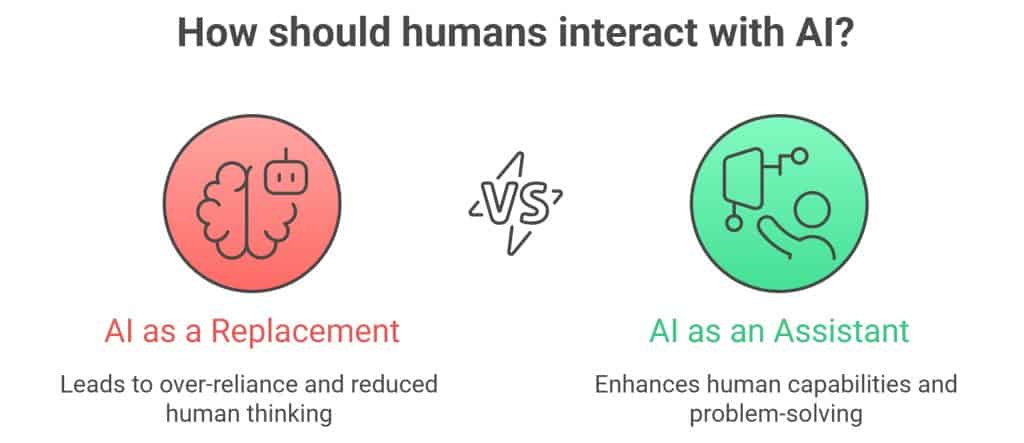
Understanding artificial intelligence begins with recognising that it belongs to a long tradition of tools that extend human capability.
Throughout history, people have developed technologies that amplify their physical or intellectual abilities. The printing press multiplied the reach of ideas. Calculators accelerated mathematical work. Computers allowed information to be processed at extraordinary speed.
Artificial intelligence is the latest step in this progression.
Rather than replacing human thinking, modern AI systems expand what individuals can accomplish by assisting with tasks that involve language, analysis, and pattern recognition. They can help draft documents, summarise information, generate ideas, or organise large amounts of data.
In this sense, AI functions much like a sophisticated assistant.
The key difference from earlier tools is that artificial intelligence operates through language and patterns rather than mechanical force. Because of this, the outputs often appear conversational and expressive, which makes the technology feel more human than it actually is.
But the underlying principle remains the same.
A hammer does not decide where to strike. A calculator does not decide which equation matters. In the same way, an AI system does not decide what should be written, analysed, or created. Those decisions remain firmly in human hands.
The most effective users of artificial intelligence recognise this relationship. They treat AI not as a replacement for thinking, but as a powerful instrument that can accelerate the process of exploration, drafting, and problem solving.
Seen in this light, the question is not whether machines will think like people. The more practical question is how people will think differently when such tools are available.
Real World Consequences
Seeing artificial intelligence as a tool rather than a mind has important consequences for how people use it.
In business environments, AI can accelerate routine work that once required hours of manual effort. Drafting documents, analysing information, and organising ideas can now happen much faster. But the responsibility for judgement, interpretation, and final decisions still rests with the person using the system.
When organisations forget this distinction, problems quickly appear. Some expect AI systems to deliver flawless answers without supervision. Others assume the technology is too unpredictable to be useful at all. Both reactions stem from misunderstanding what these systems are designed to do.
Education faces a similar challenge.
Students now have access to tools capable of generating essays, summaries, and explanations within seconds. Attempting to ignore these tools is unrealistic. Instead, the more productive approach is to teach students how to use them thoughtfully while maintaining their own reasoning and understanding.
The same principle applies to everyday life.
Artificial intelligence can help people explore ideas, organise information, and communicate more efficiently. But it should not replace personal judgement. A tool can suggest possibilities, but it cannot determine what is meaningful, ethical, or wise.
Understanding AI as a tool places responsibility exactly where it belongs. The technology expands capability, but human judgement remains the deciding factor.
A Different Way to Think About AI
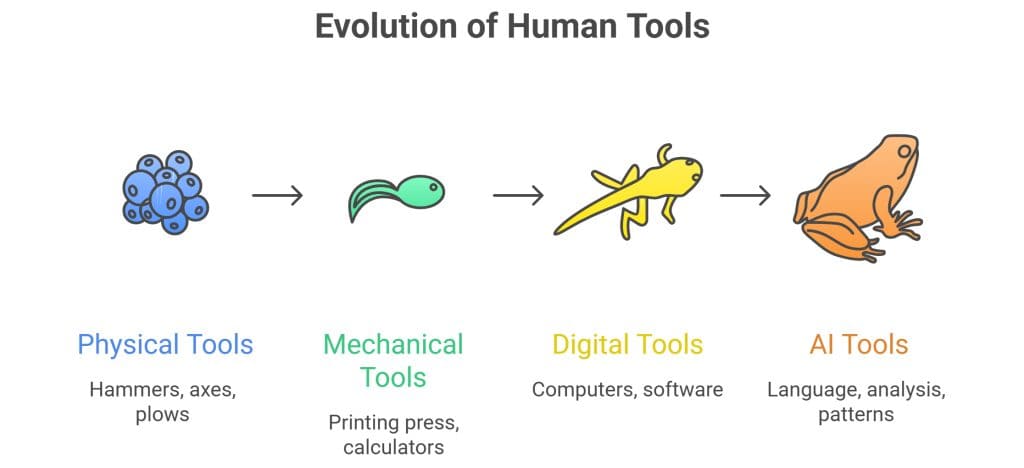
Much of the public conversation about artificial intelligence is framed around replacement. People often ask whether machines will replace human workers, human creativity, or even human thinking.
A more useful way to approach the question is to consider how technology has historically changed human capability.
When calculators became widely available, mathematicians did not disappear. Instead, routine calculations became easier, allowing people to focus on higher levels of analysis and problem solving. When computers entered workplaces, many tasks changed, but entirely new forms of work also emerged.
Artificial intelligence may follow a similar path.
Rather than replacing human thinking, it is more likely to shift how thinking is applied. Tasks that involve drafting, summarising, or analysing patterns can now be accelerated by AI tools. This allows individuals to spend more time evaluating ideas, asking better questions, and making informed decisions.
In this sense, artificial intelligence may amplify human capability rather than replace it.
The most valuable skill in such an environment is not simply knowing how to operate a tool. It is knowing how to think clearly about the outputs it produces. People who can interpret, question, and refine the results generated by AI will remain essential.
Technology can generate answers quickly. Understanding which answers matter still requires human judgement.
Final Reflection
Artificial intelligence often appears mysterious because its outputs resemble human communication. It writes sentences, answers questions, and produces ideas in ways that feel familiar to us.
But beneath the surface, these systems operate very differently from human minds.
They do not understand meaning in the way people do. They do not possess awareness, intention, or experience. What they provide instead is something equally valuable: the ability to process enormous patterns of information and generate useful outputs at remarkable speed.
When understood as a tool, artificial intelligence becomes far less threatening and far more practical.
Like earlier technologies that extended physical strength or computational ability, AI extends certain forms of intellectual work. It can help draft ideas, explore possibilities, and organise information. But the responsibility for judgement, context, and wisdom remains human.
In that sense, the future of artificial intelligence may depend less on the capabilities of machines and more on the clarity with which people choose to use them.
Technology continues to evolve.
Human judgement still determines how it shapes the world.
About the Author