
Navigating an Uncertain World
Introduction
The modern world is changing faster than most people expected. Technology advances quickly, information travels instantly, and global events can shift the direction of societies almost overnight. In such an environment, uncertainty is no longer an occasional disruption. It has become a normal part of life.
Many people respond to this constant change with anxiety or frustration. Yet uncertainty itself is not the problem. The real challenge is learning how to think, respond, and make decisions wisely when circumstances are constantly evolving.
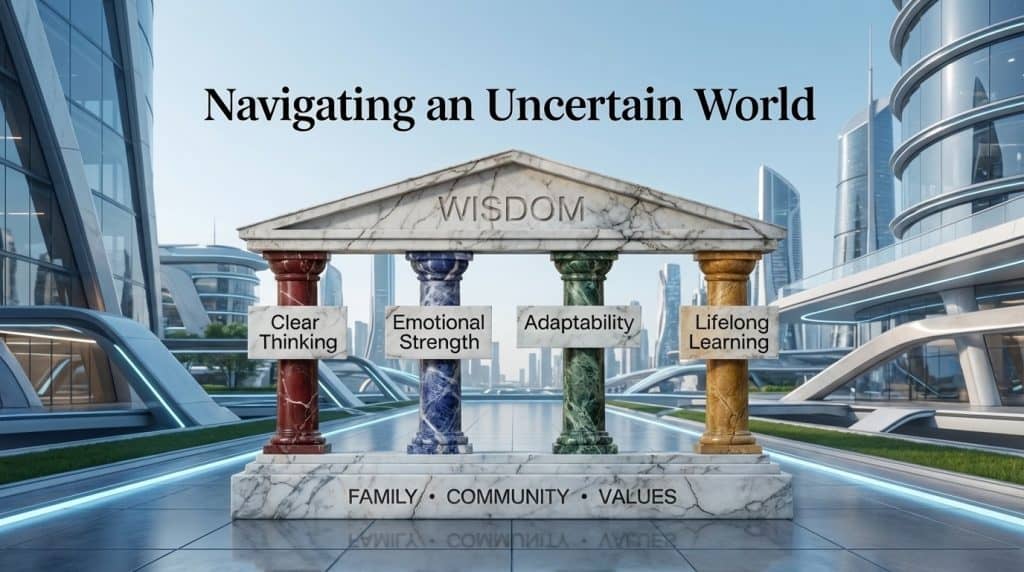
While we cannot control every external event, we can develop the inner capabilities that allow us to navigate complexity with confidence. These capabilities form a practical framework for modern life, built around four essential human strengths: clear thinking, emotional resilience, adaptability, and lifelong learning.
Together, these qualities support the development of wisdom. And in a world shaped by rapid technological change, wisdom may be the most important capability of all.
The Challenge
Modern life presents an unusual challenge. We are surrounded by more information, more technology, and more rapid change than at any previous time in history.
Artificial intelligence, digital platforms, and global networks are transforming how people work, learn, and communicate. New tools appear constantly. Industries evolve quickly. Decisions that once took months now happen in minutes.
Yet while technology has accelerated dramatically, human judgement has not changed at the same pace.
Many people feel overwhelmed by the speed of information and the pressure to respond quickly. News cycles move continuously, opinions spread instantly, and decisions are often made before there is time for careful reflection.
In this environment, reacting quickly can become more common than thinking clearly.
The result is not simply confusion. It is fatigue. When every issue appears urgent and every change appears disruptive, it becomes difficult to maintain perspective.
This is why developing strong internal capabilities is so important. In uncertain times, the most valuable advantage is not access to more information. It is the ability to think calmly, adapt thoughtfully, and continue learning.
That is where the framework of four pillars becomes useful.
The Framework: The Four Pillars of Resilience
To navigate an uncertain world, people need more than access to information. They need the ability to interpret events, respond thoughtfully, and adapt as circumstances change.
This framework is built around four essential capabilities: clear thinking, emotional strength, adaptability, and lifelong learning. Each pillar supports wise judgement in a different way. When developed together, they provide a stable foundation for navigating complexity and uncertainty.
Clear Thinking
Clear thinking is the ability to evaluate information carefully and separate facts from assumptions. In a world where information spreads instantly through social media, news cycles, and online platforms, the ability to pause and examine evidence has become a critical skill.
Clear thinking is not about reacting quickly. It is about asking better questions before forming conclusions.
For example, when a new technology such as artificial intelligence appears in the news, clear thinking asks:
- What is the actual source of this information?
- What evidence supports the claim?
- Is this prediction realistic, exaggerated, or incomplete?
People who practise clear thinking are less likely to be overwhelmed by headlines or trends. They focus on understanding rather than reacting.
Action to practise:
When encountering important information, pause and ask two questions:
What is the source? and What evidence supports this claim?
Emotional Strength
While clear thinking evaluates information, emotional strength manages how we respond to situations internally.
Uncertainty often triggers stress, fear, or frustration. These emotions can cloud judgement and lead to impulsive decisions. Emotional strength allows individuals to remain balanced even when circumstances are unclear.
This does not mean ignoring emotions. It means recognising them without allowing them to dominate decision-making.
For instance, a sudden change at work, a new technology disrupting an industry, or unexpected global events can create anxiety. Emotional strength helps people remain steady enough to assess the situation calmly and respond constructively.
People with emotional strength tend to respond rather than react. They maintain perspective and avoid being swept up by short-term pressures.
Action to practise:
During stressful conversations or decisions, pause for ten seconds before responding. This small moment often restores perspective and prevents unnecessary conflict.
Adaptability
Adaptability is the willingness to adjust when circumstances change. In previous generations, careers and industries often remained stable for decades. Today, technology and global change mean that environments evolve continuously.
Adaptability allows individuals to experiment, adjust, and improve rather than resist change.
This might involve learning a new digital tool, exploring a different way of working, or approaching a problem from a new perspective. Adaptable people recognise that change is not always comfortable, but it often creates opportunities for growth.
Rather than asking, “Why is this happening?” adaptable individuals ask, “How can I respond effectively?”
Action to practise:
Choose one small change each month that improves how you work or learn. This might be testing a new tool, adopting a different workflow, or exploring a new skill.
Lifelong Learning
Lifelong learning is the commitment to continually expanding knowledge and skills throughout life.
In an era of rapid technological advancement, education no longer ends with formal schooling. New tools, new ideas, and new challenges appear regularly. Individuals who continue learning remain capable of adapting and contributing meaningfully.
Lifelong learning does not require constant study. Often it simply means remaining curious, asking questions, and making time to explore new ideas.
For example, spending twenty minutes a week learning about a new technology, reading a thoughtful article, or exploring a different field can gradually expand perspective.
Over time, this steady habit of learning becomes one of the most powerful advantages a person can develop.
Action to practise:
Set aside a small amount of time each week to learn something new related to your interests, profession, or emerging technologies.
The Pillars Working Together
Each pillar supports the others.
Clear thinking helps us understand information.
Emotional strength helps us remain balanced while processing it.
Adaptability allows us to respond constructively to change.
Lifelong learning ensures we continue improving over time.
Together, these capabilities form a practical framework for navigating uncertainty.
But these pillars do not stand alone. They are supported by something deeper: the foundation of family, community, and personal values.
Understanding that foundation is the next step in the framework.
The Foundation: Family, Community, and Values
Every strong structure rests on a stable foundation. In the same way, the four pillars of resilience are supported by deeper elements that shape how people think, respond, and make decisions.
These foundations are family, community, and personal values.
While modern discussions about technology often focus on tools, systems, and innovation, the most important influences on human behaviour remain surprisingly simple. The people we trust, the values we hold, and the communities we belong to provide the stability needed to navigate uncertain environments.
Family often provides the first source of guidance and perspective. Family relationships can remind us what matters most when external pressures begin to dominate our attention. They help individuals maintain a sense of purpose that extends beyond short-term events or professional challenges.
Community provides connection and shared experience. Whether through professional networks, friendships, or local communities, these relationships allow individuals to exchange ideas, support one another, and maintain perspective when facing complex situations. In uncertain times, community helps prevent isolation and encourages thoughtful dialogue.
Personal values act as an internal compass. Values influence how decisions are made, how responsibilities are approached, and how individuals respond to both success and adversity. When circumstances change quickly, clear values provide a stable reference point that guides judgement.
These foundations do not eliminate uncertainty, but they provide the stability needed to face it with confidence.
When family relationships remain strong, when communities encourage thoughtful conversation, and when personal values remain clear, individuals are far better prepared to apply the four pillars of resilience effectively.
From this foundation, the final and most important element of the framework emerges.
That element is wisdom.
Final Reflection
The modern world will likely continue to change at an extraordinary pace. Technology will evolve, new challenges will emerge, and global events will continue to reshape how societies work and interact.
Uncertainty, in many ways, has become a permanent feature of modern life.
Yet uncertainty does not have to produce fear or confusion. When individuals develop the capabilities to think clearly, remain emotionally balanced, adapt thoughtfully, and continue learning, uncertainty becomes easier to navigate.
Supported by strong foundations of family, community, and personal values, these capabilities allow people to maintain perspective even when circumstances change quickly.
Above all, it is wisdom that guides how these abilities are used. Wisdom helps people decide not only what can be done, but what should be done.
Education provides knowledge.
Experience builds skill.
Wisdom guides how we use both.
In a world defined by rapid change, developing this inner compass may be one of the most valuable investments any individual can make.
About the Author