
Decision Making in the Age of AI
Why judgement matters more, not less, when machines can generate answers instantly
Introduction
Artificial intelligence has made information easier to generate than at any time in history.
Within seconds, modern AI systems can produce summaries, draft reports, generate ideas, analyse data, and answer complex questions. For many people, this creates the impression that machines are beginning to take over the intellectual tasks that once defined professional work.
But the rise of artificial intelligence is not eliminating decision making.
In many cases, it is increasing its importance.
When answers become easier to generate, the real challenge shifts to determining which answers are useful, which ideas are reliable, and which decisions are worth pursuing. In other words, the ability to generate information is becoming less valuable than the ability to interpret it.
This shift places a new emphasis on judgement.
Artificial intelligence can provide options, suggestions, and insights, but it does not understand the full context in which decisions occur. Human experience, responsibility, and perspective still play a critical role in determining what should happen next.
As AI tools become more widely available, the people who thrive may not simply be those who can generate answers quickly. They will be those who can evaluate those answers wisely.
When Answers Become Too Easy
One of the unintended consequences of artificial intelligence is that it dramatically lowers the effort required to produce information.
A question that once required hours of research can now be answered in seconds. A report that previously took days to draft can be generated almost instantly. Even complex ideas can be explored quickly through conversational prompts.
While this capability is powerful, it also introduces a new challenge.
When information becomes abundant, it becomes harder to distinguish between what is useful and what is merely plausible. AI systems are designed to produce coherent responses, but coherence does not always guarantee accuracy or relevance.
This creates a subtle risk.
If people begin to rely too heavily on automatically generated answers, they may gradually weaken the habit of evaluating information carefully. The convenience of instant responses can sometimes replace the discipline of critical thinking.
In this environment, the ability to pause, reflect, and question becomes increasingly important.
Artificial intelligence can generate possibilities, but deciding which possibilities deserve attention remains a human responsibility.
The New Decision Environment
Artificial intelligence is changing the environment in which decisions are made.
In the past, gathering information was often the most time-consuming part of solving a problem. Research required careful searching, reading, and comparison before a person could even begin forming conclusions.
Today that process can happen much faster.
AI systems can summarise articles, analyse data, generate ideas, and present multiple perspectives within seconds. This dramatically accelerates the early stages of exploration.
But speed does not remove uncertainty.
In fact, it can sometimes increase it.
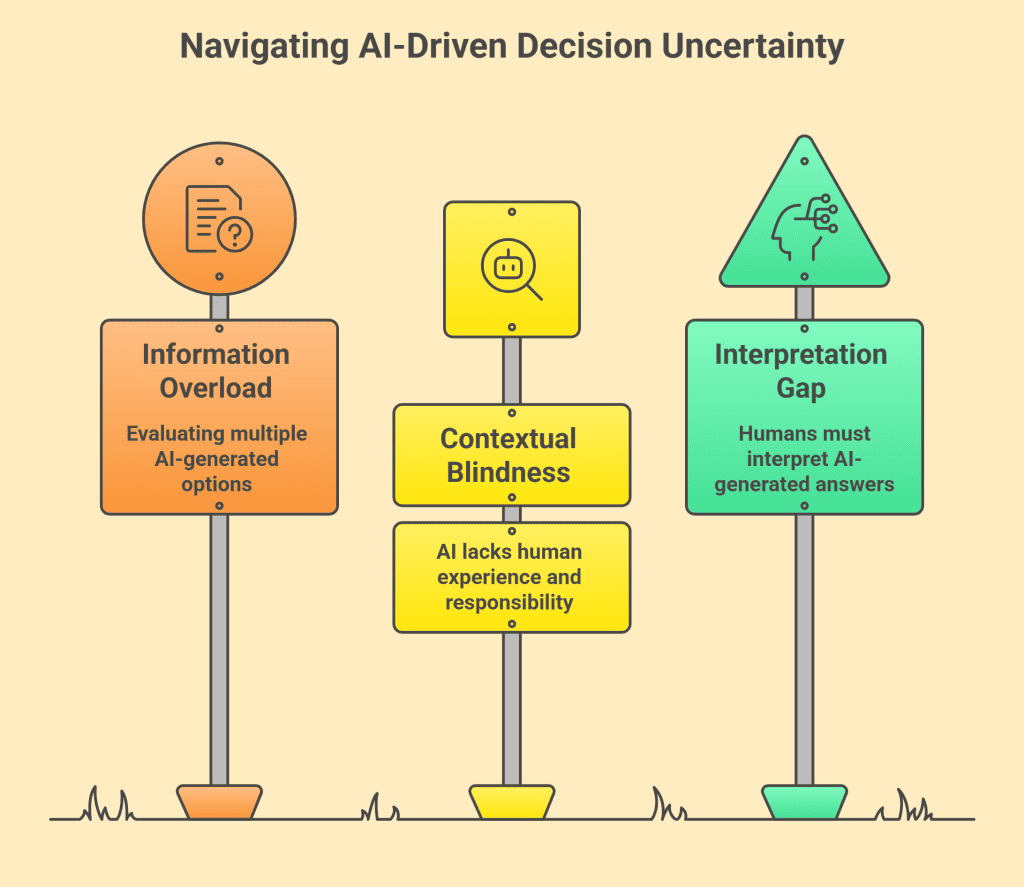
When a single question produces several plausible answers, the challenge shifts from finding information to evaluating it. Decision makers must determine which ideas are reliable, which assumptions deserve scrutiny, and which paths are worth pursuing.
This new environment places greater emphasis on judgement.
Artificial intelligence can present options, but it cannot fully understand the context surrounding a decision. It does not experience consequences, manage relationships, or carry responsibility for outcomes.
Those elements remain human.
The real skill in an AI-assisted world is therefore not simply knowing how to generate answers. It is knowing how to interpret them, question them, and decide what they mean in a real situation.
In other words, artificial intelligence changes how decisions are informed, but not who ultimately makes them.
Using AI Without Losing Judgement
Artificial intelligence can be a valuable assistant in the decision process, but it works best when used thoughtfully.
One of the most effective ways to use AI is during the early stages of exploration. A system can help outline possible approaches, summarise background information, or highlight different perspectives on a problem. This allows decision makers to examine a broader range of ideas than they might have considered on their own.
However, the outputs generated by AI should always be treated as starting points rather than final conclusions.
AI systems generate responses based on patterns in data. They do not fully understand the context of a situation, the relationships between people involved, or the consequences that may follow a particular decision. Because of this, their suggestions must always be interpreted with care.
A useful approach is to treat AI as a thinking partner rather than an authority.
It can propose possibilities, organise information, and challenge assumptions. But the responsibility for evaluating those ideas still belongs to the individual making the decision.
This perspective helps maintain balance.
Artificial intelligence can accelerate the process of exploring options, but judgement remains essential in determining which option is appropriate. By combining the speed of AI with thoughtful human evaluation, decision makers can gain the benefits of technology without surrendering responsibility for the outcome.
The Skills That Matter Most in an AI World
As artificial intelligence becomes more capable, the nature of valuable human skills may begin to shift.
In the past, expertise was often associated with the ability to gather and organise information. Professionals built their value by accumulating knowledge and developing systems to analyse it efficiently.
Artificial intelligence is now able to assist with many of these tasks.
AI tools can generate summaries, organise research, and present possible interpretations quickly. This means that the advantage no longer lies solely in producing information. Instead, the advantage increasingly lies in how that information is interpreted.
Judgement becomes central.
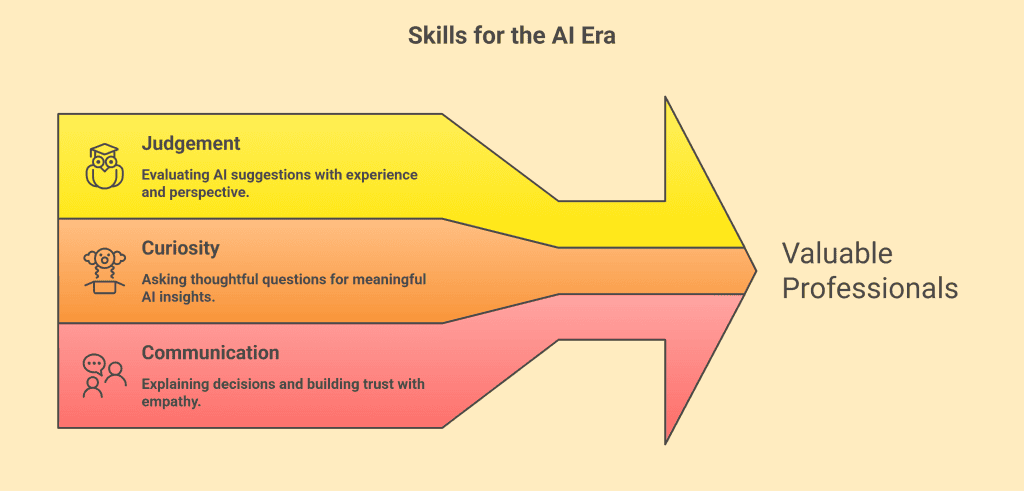
Understanding context, recognising the limits of data, and anticipating the consequences of a decision all require experience and perspective that extend beyond pattern recognition. These qualities allow people to evaluate the suggestions generated by AI and determine which ideas are worth pursuing.
Curiosity also plays an important role.
Artificial intelligence responds to prompts. The quality of the response depends heavily on the quality of the question being asked. Individuals who can frame thoughtful questions and explore problems from multiple angles are far more likely to gain meaningful insights from AI tools.
Communication remains equally important.
Even when AI helps generate information, people must still explain decisions, persuade others, and build trust. These are deeply human activities that depend on empathy, clarity, and responsibility.
In an AI-assisted world, the most valuable professionals may not be those who rely entirely on machines. They may be those who combine technological assistance with thoughtful human judgement.
Final Reflection
Artificial intelligence is transforming how information is created and shared.
Tasks that once required hours of research or drafting can now be completed in moments. Ideas can be explored quickly, alternatives can be generated instantly, and complex topics can be summarised with remarkable speed.
Yet the ability to generate answers does not remove the need for judgement.
If anything, it increases it.
When information becomes abundant, the real challenge shifts to interpretation. Someone still needs to determine which ideas are meaningful, which assumptions require caution, and which decisions are worth acting upon.
Artificial intelligence can assist with exploration, but it cannot fully understand the consequences of a choice.
Responsibility remains human.
The most effective decision makers in the years ahead will not be those who simply rely on AI to provide answers. They will be those who use these tools to expand their perspective while maintaining the discipline to question, evaluate, and decide carefully.
Technology may accelerate the flow of information.
But the quality of decisions will still depend on the clarity of human judgement.
About the Author