Understanding the AI Development Ladder
Introduction
Artificial intelligence has quickly become one of the most discussed topics of the modern age. Headlines oscillate between extraordinary promise and alarming speculation. Some portray AI as a revolutionary technology that will transform every industry, while others warn of machines surpassing human intelligence and reshaping society in unpredictable ways.
Much of this conversation, however, suffers from a fundamental misunderstanding. Artificial intelligence is often spoken about as if it were a single technology, when in reality it is better understood as a progression of capabilities evolving over time.
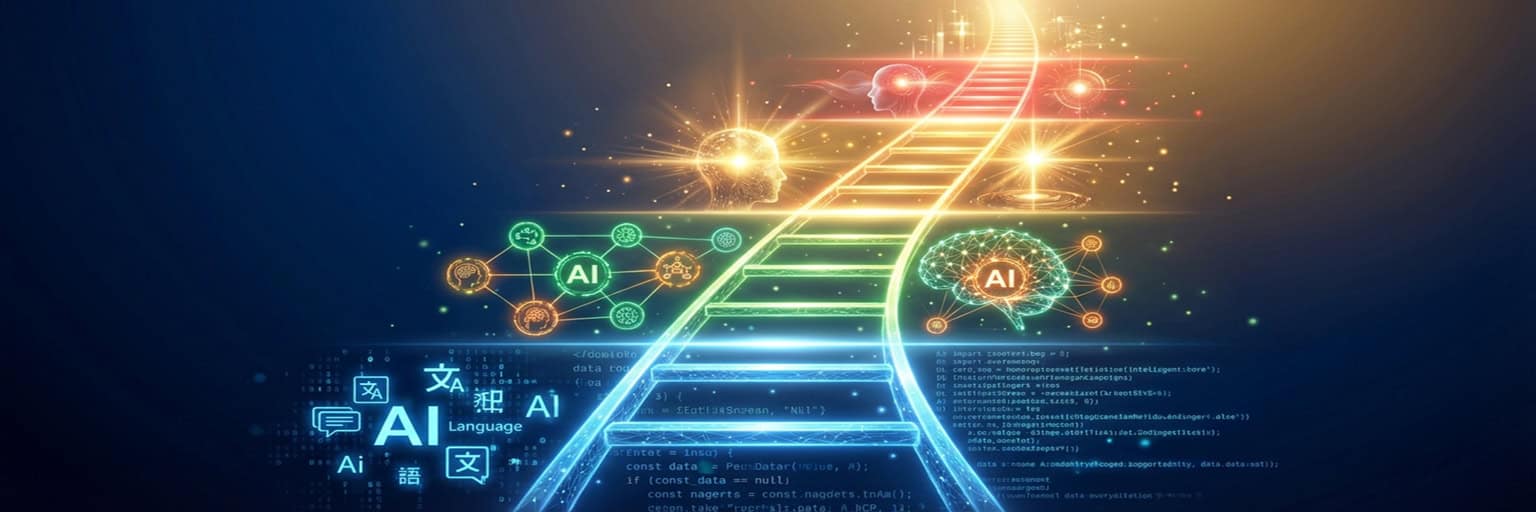
A simple way to make sense of this progression is to imagine artificial intelligence as a ladder. Each step represents a different level of capability and autonomy. The tools most people interact with today sit near the lower rungs of this ladder, while the higher levels represent systems that remain largely theoretical.
Understanding this distinction is essential. Without a clear framework, discussions about artificial intelligence easily become confused, blending present-day tools with distant possibilities.
The AI Understanding Ladder offers a simple way to separate reality from speculation.
The Problem
Public discussions about artificial intelligence often mix together very different technologies and ideas. A chatbot that writes text, a system that automates tasks, and the theoretical concept of machines with human level intelligence are frequently described as if they belong to the same category. This creates confusion.
Part of the problem comes from the speed at which AI tools have entered everyday life. In only a few years, systems such as language models, image generators, and automated assistants have moved from research laboratories into common use. Because these tools appear impressive, it is easy to assume that artificial intelligence is already approaching human level intelligence.
In reality, most current systems operate within narrow boundaries. They perform specific tasks well, but they do not possess general understanding, independent reasoning, or true awareness. When people expect these systems to behave like intelligent agents, disappointment and misunderstanding follow.
At the same time, conversations about future artificial intelligence often leap far beyond the capabilities of current tools. Discussions about superintelligence, machine consciousness, or technological singularity are sometimes presented alongside practical applications such as writing assistance or data analysis.
Without a clear structure for understanding these differences, it becomes difficult to separate what artificial intelligence can do today from what may still be decades away. A simple framework can bring clarity to this conversation.
The Framework: The AI Understanding Ladder
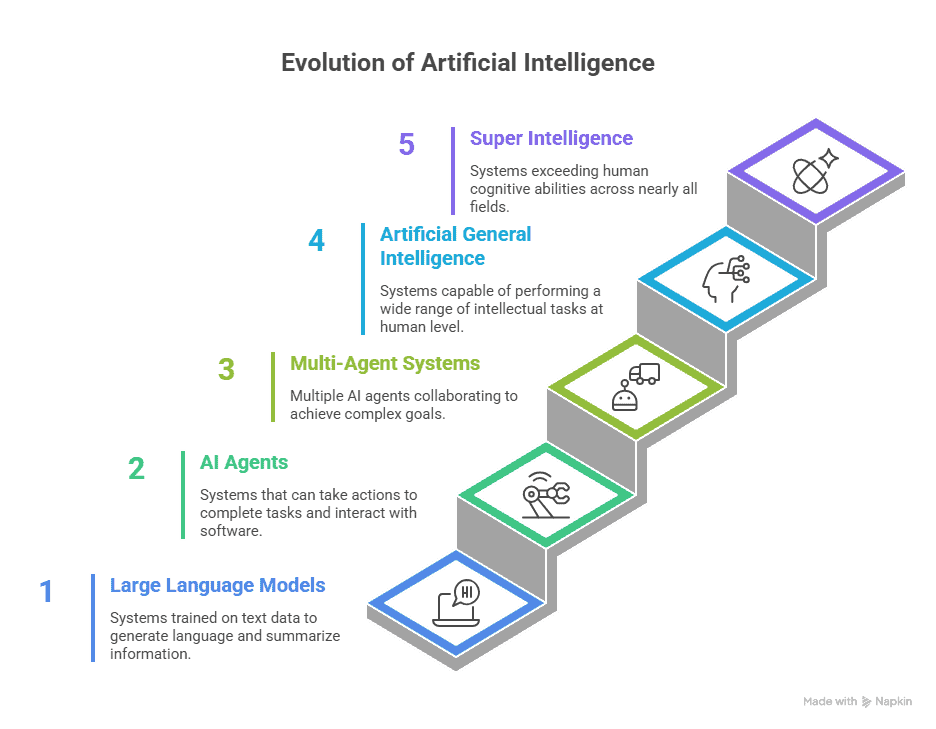
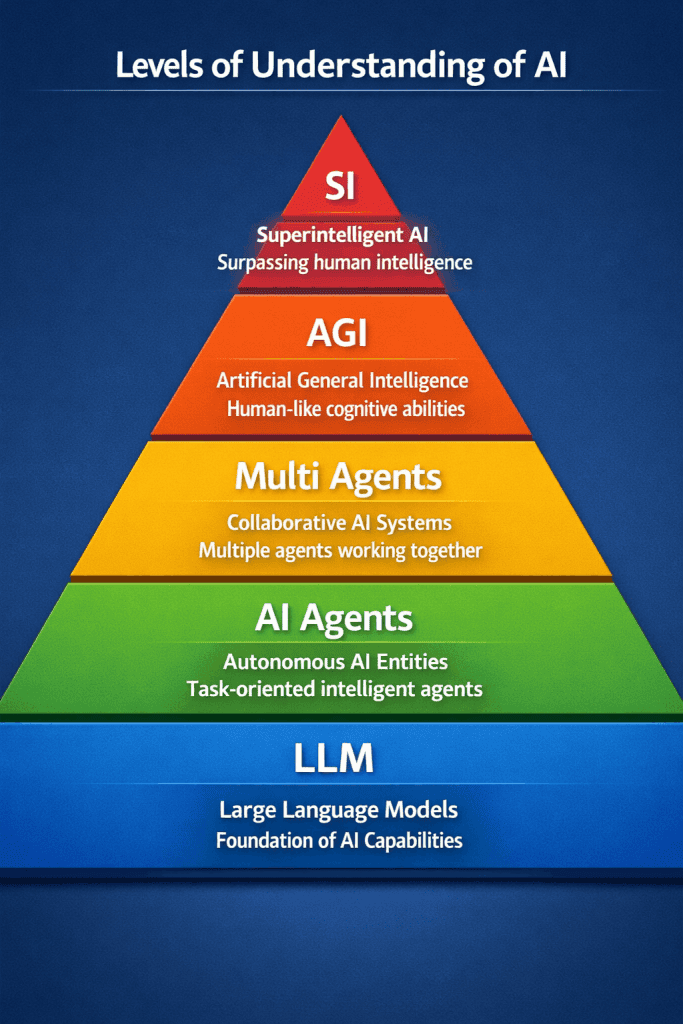
A helpful way to understand the development of artificial intelligence is to imagine it as a ladder. Each rung represents a different level of capability. As systems move upward, they become more autonomous, more flexible, and more capable of performing complex tasks.
The tools most people interact with today sit on the lower rungs of this ladder. The higher levels represent technologies that are still emerging or remain largely theoretical.
Level 1: Large Language Models
The first rung of the ladder is represented by large language models, often abbreviated as LLMs. These systems are trained on enormous collections of text and learn patterns in language. They can generate writing, summarise information, answer questions, and assist with creative tasks.
Tools such as ChatGPT and similar systems belong to this category. They can appear intelligent because they produce coherent language and respond conversationally. However, they do not truly understand the world in the way humans do. Instead, they predict likely sequences of words based on patterns learned during training.
Large language models are extremely useful, but they remain tools that respond to prompts rather than independent actors.
Level 2: AI Agents
The next step on the ladder involves AI agents. Unlike language models that simply respond to questions, agents can take actions in order to complete tasks.
An AI agent may receive an objective such as researching a topic, organising information, or completing a sequence of digital steps. It can then plan actions, interact with software tools, and adjust its approach as it progresses.
While still limited, this shift from responding to acting represents an important development in the evolution of artificial intelligence.
Level 3: Multi-Agent Systems
The third rung involves multiple AI agents working together. Instead of one system performing a single task, several specialised agents collaborate to achieve a more complex goal.
For example, one agent may gather information, another may analyse data, and a third may prepare a final report. Together they function like a small digital team, each component performing a specialised role.
Multi-agent systems begin to resemble coordinated organisations rather than individual tools.
Level 4: Artificial General Intelligence
Artificial General Intelligence, often referred to as AGI, represents a much more ambitious stage. An AGI system would be capable of performing a wide range of intellectual tasks at a level comparable to human reasoning.
Such a system could learn new skills, adapt to unfamiliar situations, and apply knowledge across many domains rather than specialising in narrow tasks.
At present, AGI remains a research objective rather than a widely available technology. While progress continues, there is still considerable debate about when or whether such systems will emerge.
Level 5: Super Intelligence
The highest rung of the ladder is sometimes described as superintelligence. This would represent a form of artificial intelligence that exceeds human cognitive abilities across nearly all fields.
Superintelligent systems remain speculative. They are discussed in philosophical debates and long term technological forecasts, but they do not yet exist.
For practical purposes, the world today operates almost entirely on the lower levels of the ladder.
Real-World Impact
Understanding the different levels of artificial intelligence is more than an academic exercise. It has practical implications for how individuals, organisations, and educators approach technology.
Many of the strongest reactions to AI today come from a misunderstanding of where current tools actually sit on the ladder. When people believe that systems like language models represent fully autonomous intelligence, they may either overestimate their capabilities or fear consequences that are far removed from present reality.
In business environments this confusion can lead to poor decisions. Some organisations hesitate to experiment with AI tools because they fear unpredictable outcomes. Others adopt technologies too quickly, expecting systems to perform tasks far beyond their design.
Education faces a similar challenge. Students now have access to powerful AI tools that can assist with research, writing, and learning. Rather than attempting to ban these technologies outright, educators need to understand how they work and where their limitations lie. When used thoughtfully, AI can support learning rather than undermine it.
For individuals, the ladder provides a useful mental model. It reminds us that today’s AI tools are sophisticated assistants rather than independent thinkers. They can accelerate work, generate ideas, and help organise information, but they still rely on human direction and judgement.
By recognising the stage of development we are currently in, it becomes easier to approach artificial intelligence with curiosity and practicality instead of confusion or fear.
A Practical Perspective
For most people today, artificial intelligence is best understood as a powerful set of tools rather than an independent force reshaping society overnight.
Large language models can assist with writing, research, and idea generation. Image systems can produce visuals quickly. Video tools can translate and present information in new ways. These capabilities are impressive, but they still rely heavily on human direction.
The most productive approach is not to fear these tools, nor to treat them as magical solutions. Instead, they should be viewed as assistants that expand what individuals and small teams can accomplish.
History shows that new technologies often appear more threatening during their early stages. Printing presses, computers, and the internet all generated similar reactions when first introduced. Over time they became integrated into everyday life as people learned how to use them effectively.
Artificial intelligence is likely to follow a similar path.
Those who develop a basic understanding of how these systems work will find themselves better positioned to benefit from them. They will recognise where AI can accelerate work, where human judgement is still essential, and where thoughtful oversight remains necessary.
In other words, understanding the ladder does not require deep technical knowledge. It simply requires a willingness to observe how technology evolves and to approach it with curiosity rather than fear.
Final Reflection
Artificial intelligence is often spoken about in dramatic terms. Headlines swing between excitement and fear, promising either a technological revolution or warning of an uncertain future.
The reality is usually more measured.
Most of the systems people interact with today sit on the early rungs of the AI ladder. They are powerful tools, capable of accelerating work and opening new possibilities, but they are still tools that depend on human judgement, direction, and responsibility.
Understanding this helps restore balance to the conversation.
Instead of reacting to every new development with alarm or hype, we can simply observe where each technology fits within the broader progression. Some advances will be incremental. Others may eventually reshape industries. But the ladder reminds us that progress happens in stages.
For individuals, the opportunity is not to predict the future perfectly. It is to remain curious, informed, and willing to learn.
Technology changes. Human wisdom still matters.
And in a world of increasingly capable machines, understanding the difference may be one of the most valuable skills we can develop.
About the Author